

Fifteen Yuan a Badge, 168.9 Billion Yuan a Market
Written as grain, read as goods
Walk into a shopping mall in a big Chinese city and you may find an entire floor filled with character merch shops. Almost everything in the cases is small. Tin badges the size of a thumbnail, acrylic stands that sit in your palm, printed sheets, plush keyrings. In China these are called guzi. The word borrows only the sound of the English word goods, and the character it landed on happens to mean grain.
The most common one is the badge, called baji in Chinese. That is another sound-borrowing, this time from the Japanese word for badge. Round and square are the standard shapes, most are tinplate, and there is a pin on the back so you can fasten it anywhere.
The crowd that buys and swaps guzi is called the guquan, the goods circle. Chinese outlets describe its core as school-age minors. In December 2025 the language magazine Yaowen Jiaozi put guzi on its list of the year's ten buzzwords. The magazine picks only ten words a year, so making the list means the word had already moved past one hobby crowd.
Small price tags, big totals
The prices are gentler than you would guess. According to Xinhua reporting, most guzi stay under 100 yuan, about 13.9 US dollars, and the most common badges run around 15 yuan each. Limited runs and rare designs are the exception, and some pass 1,000 yuan. That gap is where the nickname plastic gold came from.
Stack those small prices and the digits change. iiMedia Research, a Chinese market research firm, put the guzi market at 120.1 billion yuan in 2023 and 168.9 billion in 2024, growth of more than 40 percent in a single year. The same firm expects 308.9 billion by 2029. The online side grew with it. Guzi topics have drawn over 10 billion views on Douyin and more than 2 billion on Xiaohongshu.
Calling a bag painful is a compliment
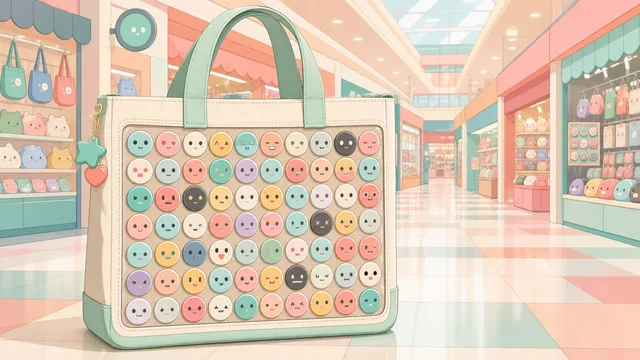
Once you own badges, the next question is where they go. Usually a bag. A bag whose front panel is packed edge to edge with badges of one character is called an itabag in Japan and a tongbao in China.
So why the character for pain? The older Japanese word is itasha, slang for a car whose body is covered in character art. It comes from calling something painful when it is embarrassing to look at. Another theory says it is a pun on ita-sha, the short form for Italian car. Japanese Wikipedia itself notes that the origin is disputed and not settled.
The rules of an itabag are simple. Collect several copies of one design and lay them out in a pattern, or keep the whole front panel to a single favorite character. Bags made for this have a clear window, so you arrange the badges inside and close it and rain never reaches them. The moment you carry one out the door, the front panel is a display case.
It started in anime fandom, but game characters and idol photocards share the same front panel now. The word guzi itself widened to cover derivative goods from comics, animation and games as a whole. Which leaves the hobby with a single requirement. The object has to be small and cheap enough that buying several does not hurt.
The order you pin them is the skill
The part that eats the most time is not buying, it is arranging. Badge diameters are mostly standard and so is the window on the bag, so you work out how many fit in how many rows before anything else. One big badge in the center ringed by small ones, alternating colors, a single row of the same expression. Each one reads completely differently.
That instinct is the same one a puzzle uses. The slots are fixed and you only change the order of the pieces. Working the tiles in the DoYouBox Sliding Puzzle, or sketching a design first in Pixel Monster, lets you see a layout before you move any real badges.
The odds table that belongs on the box
Buying guzi often runs through a draw. You buy a sealed box without knowing which design is inside, then open it. That is where money leaks, so China wrote rules in 2023. The blind box guideline from the State Administration for Market Regulation passed at a meeting on 7 June that year, and it requires sellers to post the product types, draw rules, item distribution, limited quantities, draw odds and price range where buyers can see them. Manipulating the odds from the back end is banned.
Minors got their own clause. Blind boxes cannot be sold to anyone under eight, and for buyers eight and older the seller has to confirm a guardian's consent. The guideline also encourages sellers to cap draw time, spending and the number of tries. So if you cannot find the odds table in front of a box, it may not be because you missed it.